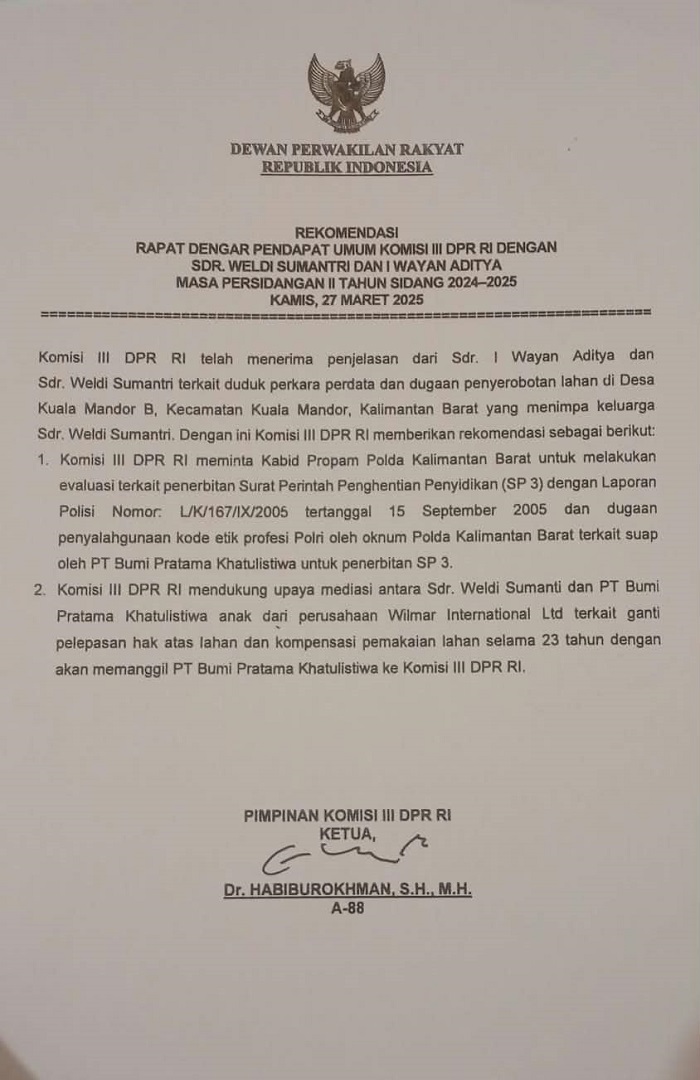
01POST.COM — PT Bumi Pratama Khatulistiwa (BPK), a subsidiary of Singapore-based palm oil giant Wilmar International Ltd. (SGX: F34), is facing mounting criticism for allegedly failing to respond to a recommendation issued by Commission III of Indonesia’s House of Representatives (DPR RI) following a Public Hearing (RDPU) in March 2025.
The company’s alleged inaction has raised questions about corporate accountability and respect for Indonesia’s legal institutions, particularly amid growing public scrutiny of the Wilmar Group’s legal and corporate governance record.
I Wayan Aditya, legal representative of the landowners, together with landowner Weldi Sumantri, expressed concern over what they described as an apparent double standard in the company’s responsiveness to legal and regulatory authorities.
According to them, Wilmar International has demonstrated a prompt response to regulatory matters abroad, including providing clarification to Singapore’s National Environment Agency (NEA) regarding forest fire issues in Indonesia.
However, they argue that the rights of Indonesian citizens involved in a land dispute spanning more than two decades have yet to receive adequate attention.
“How can the fate of ordinary citizens, whose land is allegedly unlawfully occupied and whose rights have been neglected for more than 20 years, be treated as insignificant? Such discriminatory treatment undermines Indonesia’s legal sovereignty and the public’s sense of justice,” said I Wayan Aditya.
Land Dispute Timeline and Allegations of Intimidation
The agrarian dispute concerns approximately 2,900 hectares of land in West Kalimantan, supported by a historical land ownership certificate identified as Hak Milik Swapraja No. 348/SWP/25, registered in the National Land Agency (BPN) Mempawah’s master map under Map Sheet Code OB.2, together with Land Ownership Document No. 698/2603/PK/KLA.
The landowners allege that the property was taken over without legal entitlement by PT Bumi Pratama Khatulistiwa (BPK), relying on Cultivation Rights Title (HGU) Certificate No. 59/1996.
Also Read:
CEOs gather to discuss future of cruise industry at Seatrade Cruise Asia
Malaysia’s LSS5+ Solar Photovoltaic Project Successfully Signed
Despite the landowners’ repeated efforts to resolve the matter through dialogue and peaceful negotiations, mediation attempts have reportedly reached dead ends.
Weldi Sumantri also alleged that he experienced intimidation during the dispute.
He said that after being invited to a plantation area under the pretext of determining land-map coordinates, he was confronted by a group of individuals carrying sharp weapons and pressured into signing a stamped declaration letter against his will.
These allegations raise serious concerns regarding the protection of landowners’ rights and the safety of individuals involved in agrarian disputes.
Legal Expert Questions the Company’s Legal Arguments
Responding to Wilmar’s reliance on the Administrative Court of Pontianak Decision No. 08/G/PTUN-PTK/2003 and Mempawah District Court Decision No. 14/PDT.G/2010/PN.MPW, legal expert Dr. Achmad Fitrian, S.H., M.H., from Jayabaya University, argued that these rulings should not automatically be interpreted as establishing permanent ownership or control over the disputed land.
Also Read:
CX SUMMIT 2026: FULLY LOADED AND NOT TO BE MISSED AS ASIA’S CX LEADERS GATHER IN KUALA LUMPUR
According to Dr. Fitrian, the previous administrative court lawsuit suffered from an error in objecto, meaning that the wrong object was identified in the legal proceedings.
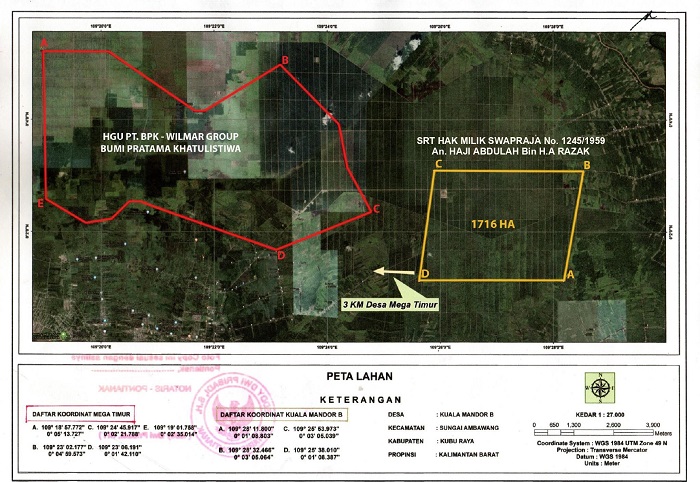
He argued that the geographical location of PT BPK’s HGU certificate was approximately three kilometers away from the land actually occupied by the local residents and claimed by the company.
Meanwhile, he explained that the Mempawah District Court case was declared inadmissible (niet ontvankelijk verklaard) because the legal representative failed to appear in court, rather than being dismissed following a substantive examination of the merits of the case.
“Under Article 124 of the Indonesian Civil Procedure Code (HIR), this case has not established ne bis in idem. Therefore, the residents’ legal right to bring a lawsuit remains open,” Dr. Fitrian explained.

His interpretation underscores the need for further legal examination of the disputed land ownership claims.
Wilmar Group’s Record of Legal and Corporate Governance Controversies
The land dispute adds to a series of legal and corporate governance issues involving companies within the Wilmar Group in Indonesia, as highlighted in the source material.
Among the cases and allegations cited are:
1. Cooking Oil and Domestic Market Obligation (DMO) Controversy (2022)
Wilmar subsidiaries were implicated in allegations involving irregularities in export approval processes and the Domestic Market Obligation (DMO) policy. The alleged economic impact on the Indonesian state was estimated at IDR 18.3 trillion.
Baca Juga:
MATRADE PARTNERS WITH HKTVMALL TO LAUNCH “DISCOVER MALAYSIA @ HKTVMALL” CAMPAIGN
Preserving Asian Culinary Heritage Through Modern Dining: The Rise of Annie Tan and Empat Sekawan
From Property Development to Industry Leadership: Tan Lindy’s Vision for BCB Berhad
2. IDR 11.8 Trillion Asset Seizure by the Attorney General’s Office (June 2025)
Indonesia’s Attorney General’s Office reportedly seized cash and assets valued at IDR 11.8 trillion from five Wilmar Group subsidiaries as part of efforts to recover alleged state losses and illicit gains.

3. Allegations of Transfer Pricing and Export Under-Invoicing (May 2026)
A cross-agency investigation involving the Ministry of Finance, the Financial and Development Supervisory Agency (BPKP), and the Attorney General’s Office reportedly identified alleged discrepancies in crude palm oil (CPO) export pricing.
One example cited involved an export price reportedly declared at US$600 per ton, compared with a reference price of US$1,119 per ton. The alleged practice raised concerns about potential profit shifting to Singapore.
4. Criminal Conviction of a Former Wilmar Executive
The Jakarta High Court reportedly increased the prison sentence of Muhammad Syafei, a former Head of Social Security and License at PT Sari Agrotama Persada, a Wilmar Group company, to eight years for bribing law enforcement officials.
Separately, I Wayan Aditya alleged that Syafei had once offered him IDR 20 billion to withdraw or discontinue the land dispute lawsuit. Aditya said he firmly rejected the alleged offer.
5. Environmental and Labor-Related Concerns
Environmental organizations, including Greenpeace and WALHI, have raised allegations concerning land clearing in High Conservation Value (HCV) areas. Amnesty International has also reported labor-standard concerns within plantation supply chains.

These issues have contributed to broader questions about the group’s environmental, social, and governance (ESG) commitments.
CEKA Reports Strong Financial Growth Amid Reputational Risks
Despite the controversies surrounding the broader Wilmar Group, its publicly listed Indonesian subsidiary, PT Wilmar Cahaya Indonesia Tbk. (IDX: CEKA), reported strong financial performance in the third quarter of 2026.
According to its financial statements as of September 30, 2026, CEKA recorded revenue of IDR 8.34 trillion, representing a 19.13% year-on-year increase.
Net profit surged by 52.26% year-on-year to IDR 243.70 billion, while total assets increased to IDR 3.04 trillion.
Although these figures indicate positive financial fundamentals, market observers may view the escalating land dispute and the alleged failure to respond to the Indonesian Parliament’s recommendation as potential reputational and governance risks.

The situation could raise broader questions about the group’s ESG performance, corporate accountability, and long-term investment credibility in Indonesia’s capital market.
Corporate Accountability and the Rule of Law
The dispute involving PT Bumi Pratama Khatulistiwa highlights a fundamental issue in Indonesia’s investment climate: economic growth and corporate profitability must go hand in hand with legal compliance, respect for property rights, and social responsibility.
For investors and international stakeholders, the case also raises questions about how multinational corporations balance their operations across jurisdictions while maintaining consistent standards of accountability.
The landowners are seeking a fair resolution and the fulfillment of their legal rights. They are also calling for greater attention to the recommendation issued by Commission III of the Indonesian House of Representatives.

The central question remains whether the company will respond to the parliamentary recommendation and engage in a meaningful resolution of the dispute.
Until the matter is resolved, the case is likely to remain an important test of corporate accountability, land rights protection, and the enforcement of the rule of law in Indonesia.
PHOTO CAPTIONS
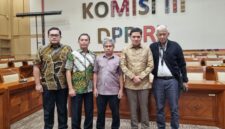
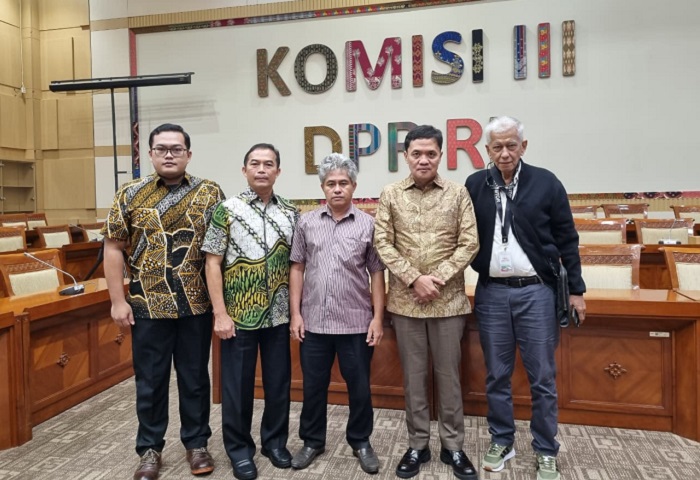
Photo 1: Landowners’ legal representative I Wayan Aditya and landowner Weldi Sumantri during a discussion with Habiburokhman, Chairman of Commission III of Indonesia’s House of Representatives.
Photo 2: Document containing the recommendation issued by Commission III of the Indonesian House of Representatives concerning the land dispute involving local landowners and PT Bumi Pratama Khatulistiwa (Wilmar Group).
Photo 3: Comparative land map showing the location of PT BPK’s HGU Certificate No. 59/1996 alongside the 2,900-hectare area claimed under Hak Milik Swapraja Certificate No. 348/SWP/25.
Media: 01POST.COM
Location: Pontianak, West Kalimantan, Indonesia